
Politics
Graduates’ and teachers’ counting on Tuesday: how preference votes are counted, how the winning quota is set, and where the counts will be held
My Maha Rashtra News Desk, Pune
Published:
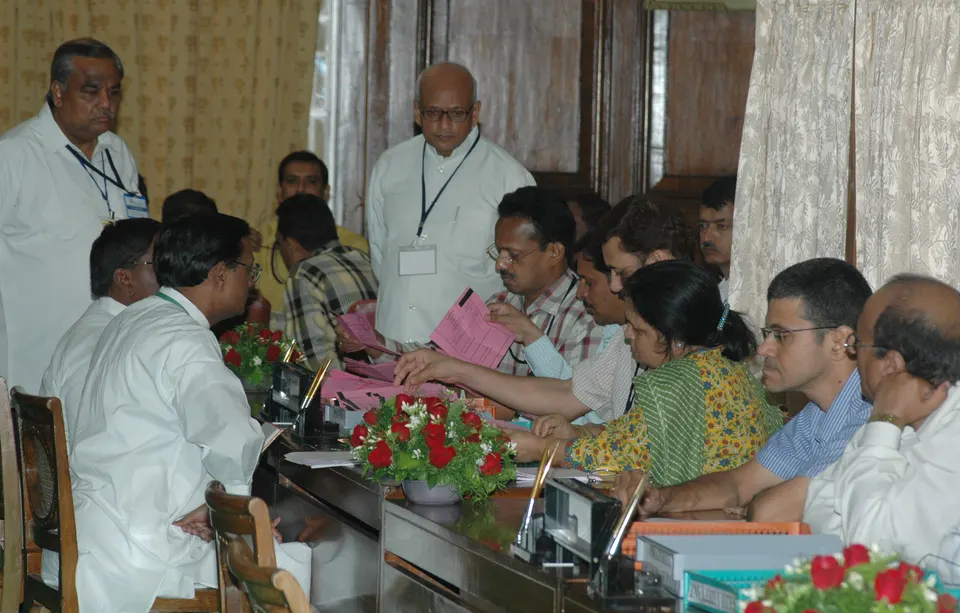
Once polling for five Legislative Council seats closes at 4 pm today, Friday, the ballot boxes go into guarded strong rooms. Counting is on Tuesday, 27 October. There are no EVMs in these elections, so every ballot paper is checked and counted by hand. Each constituency elects a single member, so a winner needs a quota of one vote more than half the valid votes. If nobody gets there on first preferences, the candidates with the fewest votes are knocked out one at a time and the next preferences on their ballots are counted. That is why results often arrive late at night or the following day.
Counting day at a glance
- Date: Tuesday, 27 October 2026. Under the Election Commission’s schedule, the whole election is to be completed by 31 October.
- Five seats, 182 candidates: Aurangabad Division Graduates 41, Pune Division Graduates 47, Nagpur Division Graduates 38, Amravati Division Teachers 26 and Pune Division Teachers 30.
- Each seat is counted separately and has its own quota.
- The divisional commissioner of each division is the returning officer and declares the result.
Where the counting will be held
- Pune graduates’ and Pune teachers’: the badminton hall of the Shree Shiv Chhatrapati Sports Complex at Balewadi. The Free Press Journal reports 100 tables in five rows for the graduates’ count and 42 tables in three rows for the teachers’ count. Ballot boxes from all five districts are being brought to Balewadi under police escort.
- Aurangabad (Chhatrapati Sambhajinagar) graduates’: from 8 am at M/s Resonte Logistics LLP, Plot E-54, MIDC Chikalthana, according to the city police. Agrowon reports 71 tables: 70 for counting and one for postal ballots. About 500 officers and staff have been assigned to the count, and 712 police personnel and a State Reserve Police Force company will guard the centre.
- Amravati teachers’: Lokshahi Bhavan in Amravati, where the ballot boxes are being kept in a strong room after polling.
- Nagpur graduates’: counting is also on 27 October, but we could not find an official announcement of the venue. Check with the Nagpur divisional commissioner’s office.
- Start time: only the 8 am start in Chhatrapati Sambhajinagar has been stated in the reports we found. We did not find announced start times for the other centres.
Step one: boxes opened, papers mixed, invalid ballots set aside
Rule 53 of the Conduct of Elections Rules, 1961 limits who may enter a counting centre: counting staff, people authorised by the Election Commission, public servants on duty, and candidates with their election and counting agents. Before counting begins, the returning officer reads out Section 128 of the Representation of the People Act, on the secrecy of the vote (Rule 54). Under Rule 73, postal ballots are dealt with first; the boxes are then opened and the number of papers in each is recorded.
In earlier counts in Maharashtra, papers from all the boxes have been mixed together before sorting. At the 2020 Marathwada graduates’ count, Lokmat reported, they were tipped into a large mixing drum and then counted in bundles of 25. Ahead of the 2023 Nashik graduates’ count, the then divisional commissioner said papers from every box would be combined into bundles of 1,000. As a result, there is no booth-by-booth or village-by-village result.
Invalid papers are separated at this stage. Under Rule 73(2), a ballot is rejected if:
- no candidate has been marked 1;
- the 1 is against more than one candidate, or it is unclear which candidate it is for;
- a candidate has both a 1 and another figure;
- it carries a mark or writing that could identify the voter;
- a figure was written with something other than the pen supplied at the booth.
- Preferences must be figures; writing them in words, such as “one” or “two”, does not count.
Step two: first preferences and the winning quota
Valid ballots are sorted into a parcel for each candidate according to the first preference, and each candidate is credited with the papers in their parcel (Rule 74). Where only one seat is being filled, every paper counts as 1, and Rule 75 sets the quota this way:
- add up the valid votes of all candidates;
- divide the total by 2;
- drop any remainder and add 1. That number is the quota.
The familiar formula, valid votes divided by the number of seats plus one, then plus one, is the rule for elections that fill several seats at once (Rule 76, under which each paper is valued at 100). With a single seat it reduces to dividing by 2. For example, the Chief Electoral Officer’s 2020 result sheet shows 2,28,259 valid votes in the Pune graduates’ seat and a quota of 1,14,130. A candidate whose first preferences meet or pass the quota is declared elected straight away.
Step three: eliminations and the transfer of next preferences
- If no one has reached the quota, the candidate with the lowest total at that stage is excluded (Rule 75(3)).
- All of that candidate’s papers are re-examined. Each one goes to whichever candidate still in the race is the next preference marked on it, and is added to that candidate’s total.
- A paper with no further preference for any remaining candidate is treated as exhausted and set aside. A paper also becomes exhausted at the point where the same figure is given to two candidates, or the sequence breaks, for instance jumping from 2 to 4 (Rule 71).
- After each transfer, officials check whether anyone has reached the quota. If not, the next lowest candidate is excluded and the process repeats.
- If two candidates are tied at the bottom, the one with fewer first-preference votes is excluded; if those are also equal, the returning officer decides by drawing lots (Rule 75(4)).
- A candidate is elected on reaching the quota, or on being the only candidate left in the count (Rule 75(2)). Because exhausted papers drop out, the last candidate standing can win with fewer votes than the quota.
- Before or after any transfer, a candidate or their agent may ask for papers to be re-examined and recounted (Rule 82).
Why the result takes so long
- It is all done by hand. The Pune graduates’ seat alone has 3,88,019 registered voters, and every ballot cast must be unfolded, checked and sorted into bundles.
- The ballots are long. Pune graduates’ has 47 candidates. If first preferences do not settle the seat, there can be many elimination rounds, and each one means sorting the excluded candidate’s papers again.
- Past counts show the pattern. In 2020, counting began on Thursday, 3 December, and the Chief Electoral Officer’s consolidated result sheet for all five seats is timed 10 pm on Friday, 4 December. That year Lokmat reported that in Marathwada, separating the valid votes and fixing the quota alone would take until about 8 pm. In 2024, the Nashik teachers’ result was declared after midnight.
- So on Tuesday, first-preference figures may come in by the evening, but final results could take until late at night, or until Wednesday.
How to follow the results
- The returning officer (the divisional commissioner) declares the result at the counting centre. Under Rule 84, the declaration is made in the prescribed form and signed copies go to the Election Commission and the state’s Chief Electoral Officer; the winner receives a certificate of election (Rule 85).
- The Chief Electoral Officer’s website, ceoelection.maharashtra.gov.in: in 2020 it published a consolidated sheet giving each seat’s valid votes, quota and the votes of the top two candidates. We could not confirm whether this year’s results will appear on the Election Commission’s results portal.
- Official updates for the Pune division are posted on divcompune.maharashtra.gov.in. For the other divisions, watch for announcements from the divisional commissioner’s office.
- When reading round-by-round numbers, keep an eye on the quota. A lead in first preferences does not settle a seat until someone reaches the quota or only one candidate is left.
- The counting hall is not open to the public. Don’t crowd outside the centre, and follow police instructions.
Sources: Conduct of Elections Rules, 1961 (Rules 51–54, 71–75, 82, 84, 85); Chief Electoral Officer, Maharashtra: Legislative Council election 2020 result sheet; Divisional Commissioner, Pune: Graduates’ and Teachers’ election 2026; Free Press Journal (Pune); Navarashtra (Pune); Pudhari (Chhatrapati Sambhajinagar counting centre); Pudhari (counting staff); Agrowon; Pudhari (Amravati teachers’); Pudhari (182 candidates); Nagpur Today; Lokmat (Marathwada count, 2020); Jansanjivani (Nashik count, 2023); Deccan Herald (Nashik teachers’, 2024)
Stay with My Maha Rashtra
Related stories
- Chhath Puja 2026: Nahay-Khay on 13 November, Sandhya Arghya on Sunday 15 November; sunset and sunrise times for Mumbai, Thane, Pune and Nagpur, and special trains home
- Nagpur graduates’ poll: NCP (Sharadchandra Pawar) expels independent candidate Nitesh Karale for six years; what the party letter says and how Karale responded
- MHADA Pune lottery: deadline to apply for 4,462 homes extended to October 30; draw on December 4
- Vidarbha's three planned expressways and Surjagad mineral road to use 6.17 crore tonnes of fly ash from Koradi, Khaperkheda and Chandrapur
- Summer vacation 2027: ‘3 May to 14 June’ is Pune district’s schedule, not the state’s; second-term and holiday dates by district
- Pune railway station sets up a separate waiting area and extra RPF cover for the Diwali–Chhath rush; platform ticket sales to stop if crowds grow
https://mymaharashtra.in/en/rajkaran/mlc-graduates-teachers-counting-27-october-quota-preference-votes-explained-10397