
Health
Mumbai's air: third on IQAir's live world list, 'moderate' on India's official index; what the two numbers mean and how to protect yourself
My Maha Rashtra News Desk, Mumbai City
Published:
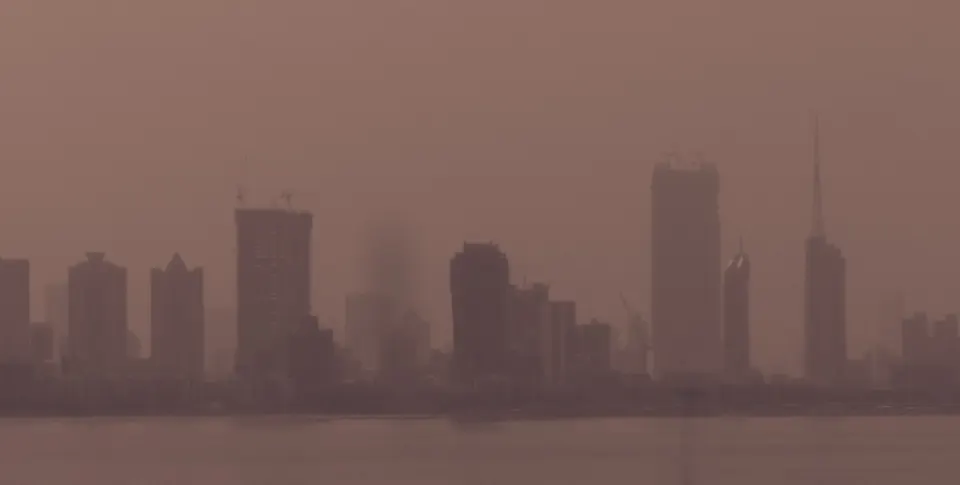
Reports since Wednesday say Mumbai is the world's third most polluted city. The ranking comes from the live world list of IQAir, a private air-quality technology company. It changes every hour and covers just over 120 major cities, not every city on earth. When we checked it at about 11 am on Thursday, 22 October, Mumbai was third with a US AQI of 170. India's official figure is different: the Central Pollution Control Board (CPCB) bulletin for 21 October put Mumbai's AQI at 113, which is in the 'moderate' band. The two numbers are on different scales, but both show Mumbai's air getting worse during October.
The numbers
- IQAir live ranking (22 October, about 11 am): Lahore first (345), Delhi second (247), Mumbai third (170). These are US AQI values.
- At different times on 21 October: Mumbai Live, citing IQAir, reported Mumbai second (167); other outlets reported it third (166). A week earlier the city was fifth on the list.
- CPCB daily AQI for Mumbai (average of the previous 24 hours, issued at 4 pm): 97 on 15 October and 99 on 16 October ('satisfactory'); 120 on 17 October, 127 on 18 October, 114 on 19 October, 102 on 20 October and 113 on 21 October ('moderate').
- On 21 October, 22 of Mumbai's 26 stations reported to the bulletin. The prominent pollutant was PM2.5, the fine particles.
- Neighbouring cities the same day: Navi Mumbai 103 ('moderate'), Thane 93 and Kalyan 78 ('satisfactory').
- According to Lokmat, Mumbai's index was 39 before Ganeshotsav and reached 110 on 2 October.
Where the air is worst
The city figure is an average of all stations, so some neighbourhoods are noticeably worse. Station readings from CPCB data, as reported:
- 20 October: BKC 160, Navy Nagar-Colaba 143, Deonar 128, Bhandup West 122, Andheri East 120 (Free Press Journal).
- 21 October: Navy Nagar-Colaba 161, Kherwadi 142, Bhandup Complex 140 (Mumbai Live).
- TV9 Marathi singled out Deonar, Chembur, Malad and BKC as areas where construction and development work have pushed readings up.
On the Indian scale all of these readings fall between 101 and 200, the 'moderate' band. None of the figures above shows a station in the 'poor' range (above 200).
Why there are two different numbers
- Different scales: IQAir reports on the US AQI scale, CPCB on India's National AQI. The bands are not the same, so 170 and 113 cannot be compared directly.
- Different time windows: the CPCB bulletin is a 24-hour average. IQAir uses hourly averages, so sudden spikes show up sooner. BMC Additional Municipal Commissioner Dr Avinash Dhakane explained this to the Indian Express, as reported by Mumbai Live.
- Different inputs: private platforms add readings from other sensors to government stations. Officials say the two systems measure different things and that comparing them directly can mislead.
- A limited list: IQAir's ranking had 126 major cities when we checked and is refreshed hourly, so 'third' describes that hour's list, not a fixed verdict.
What is driving it, according to officials and experts
- The BMC drew up its action plan expecting the AQI to worsen as post-monsoon construction resumed and the air turned drier with the change of season (Free Press Journal, 2 October).
- Construction sites are a major source of dust, and bakeries account for about 3.5 per cent of particulate emissions in the city, a BMC Environment Department officer said (Free Press Journal, 20 October).
- Construction dust, Metro and bullet-train works, vehicle exhaust and waste burning, with winds slowing after the monsoon so pollutants linger (TV9 Marathi, 18 October).
- Some experts have linked the episode to El Niño, saying warm, humid weather and weak winds keep pollution trapped near the ground (Mumbai Live, 21 October).
What the BMC is doing
In early October the BMC announced its Air Pollution Control and Enforcement Action Plan-2026. Its main provisions, and action so far:
- At least 10 pollution hotspots in every ward, each with a designated officer to monitor it.
- A 28-point rulebook for building and demolition sites. Sites that break it can be served a show-cause notice, told to halt work or, if needed, sealed. Every enforcement team must check a minimum of two sites daily.
- Barricading, tarpaulin-covered debris and continuous misting at demolition sites. Developers must keep 100 to 500 metres of adjoining road clean, depending on project size.
- Debris trucks must travel covered, with wheels washed before they reach public roads; their trips are tracked through the Mumbai Debris Control and Tracking System.
- Ward marshals and CCTV to catch open waste burning; PUC checks on busy routes.
- If a station's AQI crosses 200, extra steps such as road washing and water sprinkling. If it remains over 300 on three consecutive days, polluting activity within 2 km of that station can be suspended.
- About 3,200 construction sites are active in the city; 3,166 of them have put up AQI display boards, as directed by the Bombay High Court.
- Of the city's 593 bakeries, 354 ran on coal or wood; 174 have switched to cleaner fuel and 69 are converting.
- On 19 October the K West ward issued a stop-work notice and a Rs 35,000 fine to a redevelopment project in Oshiwara after complaints about dust (Mumbai Live).
How to check the air accurately
- CPCB's SAMEER app gives hourly National AQI updates by city. The Union health ministry's air-pollution advisory also points people to it.
- CPCB's airquality.cpcb.gov.in shows the latest reading at each station. The daily city bulletin is posted at 4 pm on cpcb.nic.in.
- Look at the station nearest you, not just the city average. CPCB's own bulletin notes that averaging hides differences between locations.
- Before comparing two figures, check the scale (Indian or US) and the time window (one hour or 24 hours).
- Indian AQI bands: 0-50 good, 51-100 satisfactory, 101-200 moderate, 201-300 poor, 301-400 very poor, 401-500 severe.
What to do
At the 'moderate' level, CPCB says people with lung disease, asthma or heart disease may have breathing discomfort. Key points from the Union health ministry's health advisory on air pollution (under NPCCHH):
- Children, pregnant women, older people, people with heart or lung conditions, and those who work outdoors are the most vulnerable. At 'moderate' levels they should avoid prolonged or strenuous outdoor exertion.
- Where you can, avoid roads with slow, heavy traffic, construction and demolition sites, and areas near polluting industries.
- When the AQI is 'poor' or worse, skip early-morning and late-evening walks, runs and exercise outdoors; keep doors and windows shut at those hours, and air the house between 12 noon and 4 pm if needed.
- If you use a mask, a disposable N95 or N99 helps for short exposures, provided it fits well over the nose and mouth and is replaced as instructed. Cloth or paper masks, handkerchiefs and scarves are not effective.
- Don't burn waste, leaves or wood in the open; avoid firecrackers; don't burn mosquito coils or incense in closed rooms; wet-mop instead of sweeping indoors.
- See a doctor if you have breathlessness, giddiness, cough, chest discomfort or pain, or red or watery eyes. People with chronic illnesses should keep their medicines at hand.
Lokmat has warned that the index could climb further around Diwali. Over the next few weeks, checking your area's AQI each day before planning outdoor activity is a sensible habit.
Sources: CPCB daily AQI bulletin (21 October 2026); CPCB daily AQI bulletin (20 October 2026); IQAir: World air quality ranking (live); Union health ministry: health advisory on air pollution (NPCCHH); Free Press Journal (20 October); Free Press Journal (2 October); Mumbai Live (21 October); Mumbai Live (20 October); TV9 Marathi (22 October); Lokmat (22 October)
Stay with My Maha Rashtra
Related stories
- Mumbai's air: High Court orders BMC, police and pollution board chiefs to appear on 26 October; firecrackers barred on roads, lanes and footpaths all year
- Chhath Puja 2026: Nahay-Khay on 13 November, Sandhya Arghya on Sunday 15 November; sunset and sunrise times for Mumbai, Thane, Pune and Nagpur, and special trains home
- Ahead of Diwali, FDA suspends licences of 9 Mumbai food outlets; Pune division cancels 15 methanol licences, suspends 28
- Seven accidents at metro sites in eight months: Bombay High Court asks MMRDA for a safety report, next hearing on 26 November
- Maharashtra weather 23–29 October: IMD sees a dry week and continuing heat, and gives no date for rain’s return
- India vs New Zealand 2nd T20I on Saturday: 12.30 pm IST start, where to watch in India, Christchurch weather and team news
https://mymaharashtra.in/en/arogya/mumbai-air-pollution-iqair-third-cpcb-aqi-what-to-do-10374